Picture this.
- Gurukul Magic: When Learning Was Life Itself
- The Colonial Disruption: When Education Became a Factory
- Coaching Factories: The New Gurukuls Gone Wrong
- Gurukul vs Coaching Factory: A Brutal Comparison
- Are We Romanticizing the Past?
- NEP 2020: A Step Toward Balance
- The Future: Hybrid Gurukuls Powered by Technology
- The Big Rethink India Needs
- Wrapping Up: Reclaiming India’s Learning Soul
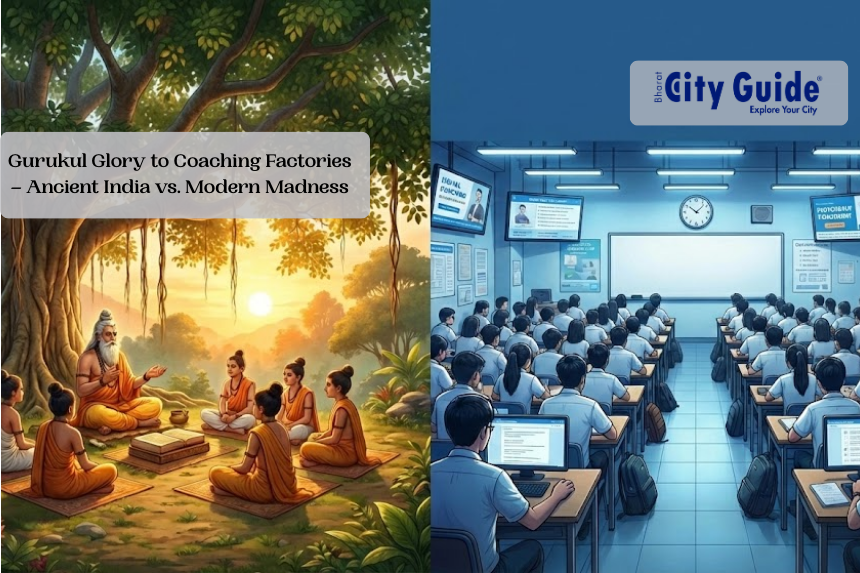
Chanakya sits under a banyan tree, his sharp eyes scanning a young Chandragupta Maurya. No classrooms. No fees. No exams. Just deep conversations on leadership, ethics, economics, war, and human nature. Knowledge flowed through dialogue, debate, observation, and lived experience.
Now hard cut to Kota, 2026.
Two lakh teenagers wake up before sunrise. Classes run for 10–12 hours. Mock tests every Sunday. Rankings every month. Anxiety every night. Parents track scores like stock prices. Dreams hinge on a single exam.
Same land. Same civilization.
So what happened to India’s learning soul?
Ancient India perfected holistic education. Modern India, in many places, produces rote-learning robots. This is not a nostalgia trip. This is a necessary comparison—because the future of Indian education depends on one question:
Why can’t we blend the best of both worlds?
Gurukul Magic: When Learning Was Life Itself
Education in ancient India was not preparation for life.
It was life.
Nalanda: The World’s First Global University
Founded in the 5th century, Nalanda University hosted over 10,000 students and 2,000 teachers from China, Korea, Tibet, Sri Lanka, Persia, and Southeast Asia.
What did they study?
- Vedas and Upanishads
- Logic and debate
- Medicine and surgery
- Mathematics (including zero)
- Astronomy and metaphysics
Students lived on campus. Education, food, and shelter were free. Funding came from kings and donations—not student loans.
The goal wasn’t employment.
The goal was enlightened citizenship.
Takshashila: Where Skills Met Wisdom
Takshashila was another giant. It produced:
- Sushruta, the father of surgery
- Masters of economics, warfare, governance, and medicine
Learning was practical. Surgeons practiced on vegetables. Warriors learned strategy before weapons. Philosophers debated ethics before preaching it.
Values Before Syllabus
The Vedic education system emphasized:
- Sanskar (values and character)
- Discipline and self-control
- Respect for nature
- Duty toward society
Children learned archery, farming, music, astronomy, and ethics through stories, observation, and mentorship—not memorization.
No ranks.
No fear.
No comparison.
The Colonial Disruption: When Education Became a Factory
Everything changed in 1835.
Thomas Babington Macaulay famously dismissed Indian knowledge systems as “worthless” and pushed for an English-based, exam-driven education model designed to produce clerks for the British Empire.
The purpose of education shifted:
From wisdom → to obedience
From thinking → to following
From character → to certificates
The Lingering Colonial Hangover
After independence, India expanded access to education, which was necessary and noble. Institutions like IITs and AIIMS became global brands.
But the underlying structure remained colonial:
- Standardized exams
- Rote memorization
- English dominance
- Ranking-based worth
The result?
According to ASER 2025, nearly 90% of Class 8 students struggle with basic division. Degrees increased. Learning declined.
Coaching Factories: The New Gurukuls Gone Wrong
Nowhere is this more visible than Kota.
What began as focused mentoring has become a ₹58,000 crore coaching industry. Hostels packed tighter than train compartments. Teenagers living away from home at 15. Mental health treated as weakness.
Neha’s Story
Neha scored 99% in board exams. Teachers praised her. Parents bragged. But inside, she was crumbling. Endless tests. Constant comparison. Fear of failure.
She didn’t fail an exam.
She broke under pressure.
Today, she’s in therapy, trying to rebuild her confidence.
She’s not alone.
Every year, exam pressure leads to anxiety, burnout, and, tragically, suicides. When education becomes a pressure cooker, learning dies.
Gurukul vs Coaching Factory: A Brutal Comparison
| Ancient Gurukul | Modern Coaching Factory |
| Guru as mentor | Teacher as syllabus-completer |
| Learning by doing | Learning by memorizing |
| Values central | Marks central |
| Community living | Isolated competition |
| No exams | High-stakes testing |
| Purpose: wisdom | Purpose: rank |
The contrast is painful—but instructive.
Are We Romanticizing the Past?
Let’s be honest.
Ancient systems had flaws:
- Limited access
- Gender and caste exclusions
- Lack of mass scalability
Modern education brought:
- Wider access
- Scientific rigor
- Global mobility
So the solution is not going backward.
The solution is blending forward.
NEP 2020: A Step Toward Balance
The National Education Policy 2020 is India’s boldest attempt to reconnect with its roots while embracing the future.
Key shifts include:
- Multilingual education in early years
- Focus on skills, creativity, and critical thinking
- No rigid separation between arts, science, and commerce
- Reduced exam stress
- Emphasis on experiential learning
It’s not perfect—but it’s a start.
Kerala: A Living Example
Kerala didn’t wait for policies. It invested in:
- Community learning
- Teacher training
- Public libraries
- Parent involvement
The result? India’s highest literacy rate and strong learning outcomes—without Kota-style pressure.
The Future: Hybrid Gurukuls Powered by Technology
Now imagine 2040.
Small learning pods replace mega-schools. AI tutors simulate debates with Chanakya, Aryabhata, or Gargi. Students learn math through farming data, ethics through real-world dilemmas, and science through experimentation.
Technology doesn’t replace teachers.
It amplifies mentorship.
Rural India benefits most:
- Solar-powered learning centers
- Vernacular digital content
- Community mentors + AI tools
This is not fantasy. Pieces of it already exist.
The Big Rethink India Needs
India doesn’t lack intelligence.
India lacks educational courage.
Courage to:
- Value curiosity over conformity
- Reward effort, not just outcomes
- Treat mental health as essential
- Accept multiple definitions of success
Modern tools + ancient wisdom can create unstoppable Indians.
But only if we stop asking:
“Kitna score aaya?”
and start asking:
“Kya seekha?”
Wrapping Up: Reclaiming India’s Learning Soul
From banyan trees to coaching factories, India’s education journey tells one truth:
When learning loses meaning, success loses joy.
Ancient India taught us how to think.
Modern India taught us how to compete.
The future must teach us how to live well.
Question for You
If Chanakya walked into a modern classroom today, what do you think would shock him the most?
Drop your thoughts below.