Imagine little Ravi from a dusty village in Bihar, staring at the stars one quiet night in 2010. His father, a daily-wage laborer with cracked hands and tired eyes, tells him the sentence millions of Indian parents repeat like a prayer:
“Beta, padhai karo, naukri milegi.”
- Education: More Than “Padhai Karo, Naukri Milegi”
- The Hidden Superpowers of Learning
- What Education Really Builds
- Ancient India Knew This Already
- Jobs vs. Joy: The Real Battle
- Gurukuls, NEP 2020, and the Middle Path
- Indian Realities: From Slums to Startups
- Urban India: Learning Without Classrooms
- The Pressure Cooker We Refuse to Talk About
- The Future of Education in India
- Wrapping Up: Education Is Freedom
Fast-forward to 2026.
Ravi is not standing on a factory floor or waiting outside an office gate with a resume. Instead, he is running a small but meaningful startup. Through a free online course on Khan Academy Hindi, he learned basic coding. He noticed a problem around him: farmers in his village were being cheated by middlemen because they didn’t know real-time crop prices. Ravi built a simple mobile app to solve that. Today, his startup helps hundreds of farmers and earns him around ₹5 lakh a year.
That’s education doing its real magic.
Not just a paycheck.
Not just a job title.
But freedom.
Education: More Than “Padhai Karo, Naukri Milegi”
We’ve all heard it growing up:
“Education is for a good job.”
But what if education is actually much bigger than that?
In India, where 1.4 billion dreams collide every single day, education shapes everything—from the conversations over morning chai to the direction of the national economy. It influences how we think, vote, question, create, and survive.
As we begin this 30-day journey into India’s learning revolution, Day 1 sets the foundation. Today, we unpack why education is essential far beyond the 9-to-5 grind.
And no, this won’t sound like your school textbook.
The Hidden Superpowers of Learning
Think of education like masala in biryani.
You can eat rice and vegetables without it, but something important will always be missing.
Yes, jobs matter. They pay bills and put food on the table. But education goes deeper. It rewires the brain.
It teaches:
- How to solve problems instead of waiting for instructions
- How to empathize, not just compete
- How to fall, learn, and stand up again
A Real Indian Story: Sunita from Rajasthan
You may have heard of Malala Yousafzai. But India has thousands of similar stories that rarely make headlines.
Sunita was married at 14 in rural Rajasthan. Everyone told her that education was over. At night, after finishing household work, she studied secretly under a lantern. Years later, she trained as a solar engineer. Today, she helps power over 50 villages with clean energy.
Education didn’t just give Sunita a salary.
It gave her the courage to question traditions, the confidence to lead, and the skills to serve society.
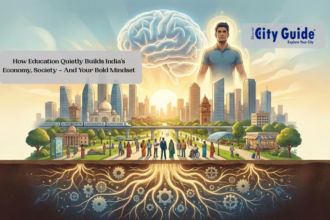
What Education Really Builds
1. Mindset Shift
Education turns “I can’t” into “Kaise karun?”
That mindset is the backbone of the Indian hustle.
2. Society Builders
Educated citizens:
- Vote more consciously
- Ask better questions
- Resist corruption
- Build stronger communities
After the 1991 economic liberalization, India’s literacy rate rose from 52% to 77%. That jump played a massive role in fueling the IT boom and middle-class expansion.
3. Economic Engine
According to McKinsey, every additional year of schooling can add up to 10% to long-term GDP growth. That’s not just personal success—that’s national power.
No wonder India dreams of becoming a trillion-dollar economy.
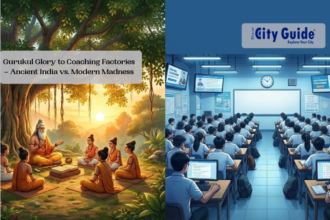
Ancient India Knew This Already
Education in India was never meant to create obedient clerks.
At Nalanda University, students debated:
- Astronomy
- Medicine
- Philosophy
- Mathematics
- Ethics
Learning was holistic. The goal was wisdom, not certificates. Knowledge was meant to sustain civilizations, not just companies.
Somewhere along the way, we forgot that.
Jobs vs. Joy: The Real Battle
From Rajkot to Delhi, one dream dominates Indian households:
“Beta/Beti, bas settle ho jao.”
IIT. IIM. Engineering. MBA.
But reality paints a different picture.
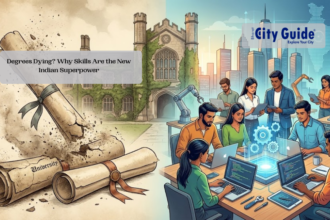
By 2025, reports show nearly 1.5 crore educated Indian youth remain unemployed. Degrees alone are no longer enough. Why?
Because degrees often teach theory, while life demands skills.
Meet Priya from Mumbai
Priya was a successful banker on paper. In reality, she was burnt out, anxious, and exhausted. One day, she quit. Instead of starting over from zero, she upskilled through digital marketing courses on Coursera, focusing on Indian creator-led programs.
Today, Priya freelances globally, earns well, and travels with her child.
Education didn’t trap her.
Education freed her.
Gurukuls, NEP 2020, and the Middle Path
Ancient gurukuls had no exams, no ranks, no fear. Students learned by living with their teacher.
Modern India can’t fully return to that system—but it can adapt the spirit.
The National Education Policy (NEP) 2020 signals this shift:
- Focus on skills over rote learning
- Multiple career pathways
- Emphasis on critical thinking
It’s an attempt to balance ancient wisdom with modern needs.
Indian Realities: From Slums to Startups
Dharavi: From Waste to Code
In Dharavi, Asia’s largest slum, NGOs like Teach For India are changing destinies. Children of waste-pickers are learning coding, communication, and leadership.
One alumnus, Arjun, built a recycling-tracking app that crossed 1 lakh downloads.
Education bridged inequality—from zero to hero.
Rural Bharat’s Struggle and Hope
According to ASER 2025, nearly 50% of rural children cannot read Class 2-level text. This is alarming.
Yet, hope exists:
- DIKSHA provides content in regional languages
- Solar-powered tablets reach remote villages
- Gujarat alone serves over 10,000 villages through digital education
Urban India: Learning Without Classrooms
Bengaluru’s coding bootcamps produce startup founders every year.
Byomkesh from Kerala dropped out of college, learned AI from YouTube, and today works as an AI ethicist at a top firm.
No campus. No degree.
Just learning, curiosity, and execution.
The Pressure Cooker We Refuse to Talk About
Education in India has a dark side.
Every year, JEE preparation pressure leads to student suicides, especially in places like Kota. Dreams become toxic when education turns into a survival race.
Look at Finland—one of the world’s top education systems:
- Minimal exams
- Maximum play
- Focus on curiosity, not fear
India@2047 can choose this path too—if we dare to rethink success.
The Future of Education in India
By 2035, AI will handle most repetitive jobs.
Education must evolve to focus on:
- Creativity
- Ethics
- Emotional intelligence
- Collaboration
Imagine adaptive learning apps—like Duolingo, but for life skills, personalized for every Indian child.
With 500 million learners, India could become a global human-capital superpower.
But only if we pivot now.
Wrapping Up: Education Is Freedom
Education is not a ladder to a job.
It’s wings to freedom.
From Ravi’s village app to Priya’s global freelancing life, education breaks chains:
- Poverty
- Bias
- Fear
Ancient sages understood this truth. Modern India must reclaim it.
Question for You
What’s one “useless” school lesson that secretly superpowered your life?
Drop it in the comments.
Tomorrow: Ancient India’s Learning Magic vs. Today’s Chaos
Stay tuned—your brain will thank you.