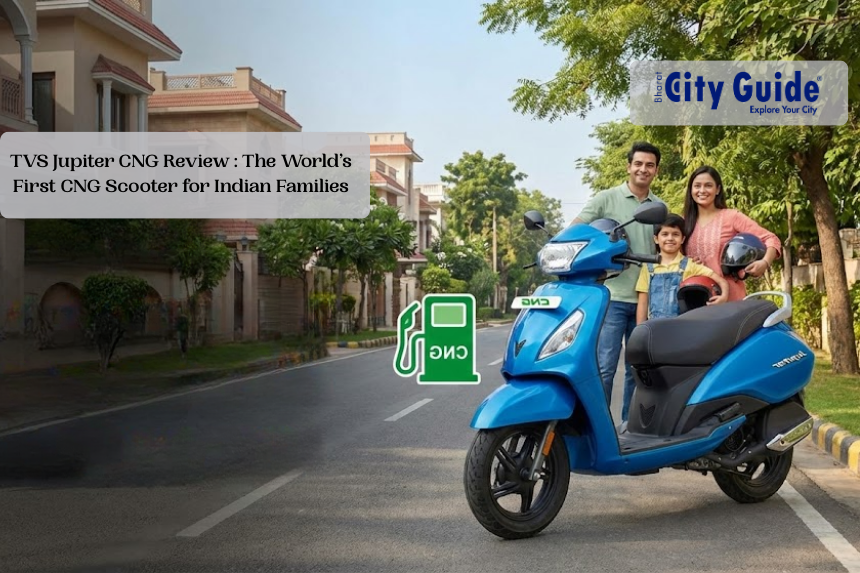
In early 2025, TVS Motor Company made a landmark move by launching the world’s first CNG scooter, the TVS Jupiter CNG. This isn’t just a new scooter—it’s a potential game-changer for India’s 2-wheeler market. With petrol prices hovering around ₹110 per litre and CNG at approximately ₹100 per kg, the Jupiter CNG offers a compelling alternative for daily commuters who want massive savings without the EV charging hassle.
- Launch Context: Why Jupiter CNG Matters Now
- Design & Road Presence: Familiar Jupiter, Eco-Smart Upgrade
- Engine & Performance: Petrol Peppy, CNG Efficient
- Ride Comfort & Handling: Smooth Over Speed Breakers
- Interior, Features & Tech: Practical and Simple
- Safety Features: Basic But Effective
- Mileage, Range & Running Cost: CNG Saves Big
- Price & Variants (Ex-Showroom)
- Who Should Buy the TVS Jupiter CNG?
- Who Should Avoid the Jupiter CNG?
- Pros & Cons
- Things Dealers Won’t Tell You
- Ownership Cost Snapshot (10,000 km/year)
- Best Alternative
- Future Relevance (2025–2030)
- Final Verdict
- Quick Buyer Tip
- Reader Question
As cities like Delhi, Mumbai, Bengaluru, and Hyderabad choke with traffic and fuel costs rise, dual-fuel technology is becoming a practical solution. The Jupiter CNG targets the 10 crore scooter families who want greener commuting and lower running costs, while still relying on familiar petrol infrastructure.
Real-world tests show the Jupiter CNG can be 20% cheaper per km compared to petrol scooters. In a country where every rupee counts, this is a major advantage.
Launch Context: Why Jupiter CNG Matters Now
The Jupiter CNG was first showcased as a global-first innovation at Auto Expo 2025, and was launched mid-year at a price range of ₹90,000 to ₹1,00,000. The scooter blends a 110cc petrol engine with a CNG tank, allowing riders to switch seamlessly between fuel modes.
TVS positioned this scooter for urban commuters who travel 30–50 km daily and want to reduce fuel bills without shifting to electric scooters. This is especially relevant in metro cities where EV charging infrastructure is still growing and long-distance rides are common.
Real-world data indicates that the Jupiter CNG can cut fuel expenses by up to 20% per km, making it a smart choice for families who rely on scooters for daily commuting and small trips.
Design & Road Presence: Familiar Jupiter, Eco-Smart Upgrade
The Jupiter CNG retains the familiar Jupiter design—smooth curves, premium chrome accents, and a clean profile. The CNG tank is cleverly integrated, with the CNG filler cap placed near the petrol cap, ensuring the scooter doesn’t look bulky or awkward.
The scooter comes with 12-inch wheels and drum brakes (disc variant also available), which make it ideal for city streets and narrow lanes. The overall stance is confident and practical, giving a premium feel in busy markets and bazaars without looking “geeky” or overly futuristic.
Engine & Performance: Petrol Peppy, CNG Efficient
The TVS Jupiter CNG uses a 113cc single-cylinder engine that produces:
- Petrol mode: 8 hp
- CNG mode: ~7 hp
It comes with a CVT automatic transmission and is designed for city commuting. The scooter tops out at around 55 kmph, making it suitable for urban roads and short highway stretches.
In petrol mode, the Jupiter feels peppy and responsive at traffic signals. In CNG mode, power dips slightly, especially uphill, but the scooter remains stable and usable even with a 80kg rider and pillion. Vibration stays minimal beyond 3,000 rpm, and the scooter can maintain comfortable cruising speeds for 40 km/h average city rides.
Ride Comfort & Handling: Smooth Over Speed Breakers
TVS has tuned the Jupiter CNG for comfort. It features:
- Telescopic front forks
- Twin rear shocks
This setup absorbs speed breakers and road undulations better than many rivals, including the Honda Activa. The upright riding posture is comfortable for 50 km rides, and the scooter feels stable at corners up to 60 kmph.
Weighing only 105 kg, the Jupiter CNG is light and easy to handle in traffic. The self-cancel indicators are a helpful feature that prevents accidental lane-change confusion, especially in busy metro roads.
Interior, Features & Tech: Practical and Simple
The Jupiter CNG focuses on daily usability rather than flashy tech. Features include:
- Analogue-digital instrument console
- Fuel mode indicator
- USB charging port
- External CNG switch in glovebox
- 22L under-seat storage
- Econometer for fuel-efficient driving
- Optional Bluetooth connectivity for calls
The scooter’s practicality makes it ideal for daily commuting, especially for families who want low maintenance and high convenience.
Safety Features: Basic But Effective
Safety is handled well for a commuter scooter. The Jupiter CNG offers:
- CBS (Combined Braking System)
- iGO assist for preventing rollback on inclines
- ISG start-stop for fuel savings
- Tubeless tyres for puncture resistance
- Sturdy build quality for side impacts
- Grab rails for pillion safety
ABS is not necessary at the scooter’s top speed, but the overall safety package is solid for city commuting.
Mileage, Range & Running Cost: CNG Saves Big
The biggest advantage of the Jupiter CNG is running cost.
Mileage
- Petrol: 50 kmpl
- CNG: 55–60 km/kg (city 50 km/kg)
Range
- Combined petrol + CNG range is around 150 km
- CNG costs approximately ₹2/km
- Petrol costs around ₹4/km
This translates to ₹50 saved daily on a 50 km commute. Over a month, that’s nearly ₹1,500 saved, making the Jupiter CNG extremely attractive for cost-conscious riders.
Annual service costs are around ₹1,500 per 3,000 km, and resale value remains strong at around 70%, thanks to TVS’s brand trust and practicality.
Price & Variants (Ex-Showroom)
| Variant | Price (Ex-showroom) | Fuel Capacity |
| Drum | ₹89,064 | 5.1L petrol + 2kg CNG |
| Disc | ₹93,564 | 5.1L petrol + 2kg CNG |
Who Should Buy the TVS Jupiter CNG?
- Urban commuters with 30–50 km daily travel
- Families looking to cut fuel costs
- Riders near CNG stations
- Eco-conscious buyers who don’t want EV hassles
Who Should Avoid the Jupiter CNG?
- Riders needing highway speeds over 80 kmph
- Areas with limited CNG stations
- Performance-focused riders
Pros & Cons
Pros
- Very low running costs
- Seamless dual-fuel switching
- Comfortable ride
- Low maintenance
Cons
- Limited CNG range
- Slight power drop in CNG mode
- Dependence on CNG stations
Things Dealers Won’t Tell You
- CNG tank needs annual inspection and possible replacement (around ₹2,000)
- Avoid overfilling the CNG tank
- CNG switchovers should be smooth—test it during a test ride
Ownership Cost Snapshot (10,000 km/year)
- Buy: ₹90k
- Annual fuel + service: ₹15k
- Resale after 5 years: ₹65k
Best Alternative
Honda Activa – best for pure petrol reliability and resale value.
Future Relevance (2025–2030)
CNG infrastructure is expanding rapidly, and is expected to hit 10,000 stations by 2030. This makes CNG scooters a strong bridge to future green fuels and even hydrogen-based mobility. The Jupiter CNG could be the most practical alternative to EVs for years to come.
Final Verdict
The TVS Jupiter CNG is a worthwhile buy for cost savings, especially for city commuters. The drum variant offers the best value. However, if you live far from CNG stations or travel highways frequently, you may want to wait or choose a petrol scooter.
Quick Buyer Tip
Map nearby CNG stations and test the switch between petrol and CNG during the test ride. This will ensure smooth daily commuting.
Reader Question
Is a CNG scooter worth the switch? Share your fuel bill stories and savings experiences!