She Hides Behind Your Dupatta—And Your Heart Tightens
It’s parent-teacher meeting day at your Rajkot kindergarten.
- She Hides Behind Your Dupatta—And Your Heart Tightens
- Quiet Is Not a Problem to Fix
- Understanding Emotional Development in the 0–5 Years
- Why Forcing Confidence Backfires
- The Real Goal: Safety Before Social Skills
- Practical, Gentle Tips to Help Your Shy Child Thrive
- Common Pitfalls (And Why They Increase Anxiety)
- What Confidence Really Looks Like
- The Long-Term Picture: Quiet Strength in a Noisy World
- A Gentle Reminder for Parents
- Try This Today
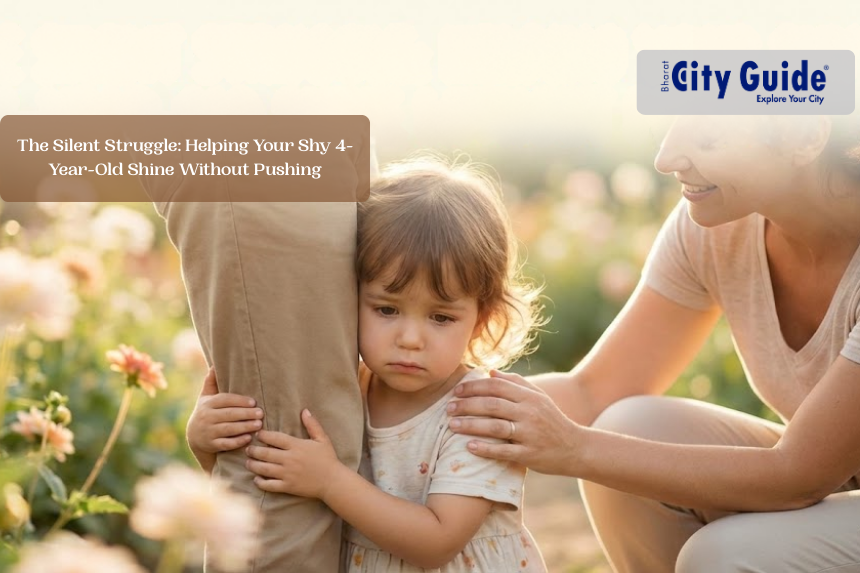
Other children run around the classroom—laughing, shouting, grabbing toys, showing drawings. Meanwhile, your 4-year-old clings tightly to your dupatta. When the teacher gently invites her to join a game, she whispers a soft but firm “no.”
You smile outwardly, but inside your mind races:
- Is something wrong?
- Why won’t she mix with other kids?
- Will she struggle later in school?
If this feels familiar, pause right here.
Your child is not broken.
Your child is not behind.
And most importantly—your child is not failing at life.
She is developing exactly as her brain and temperament are wired to.
Quiet Is Not a Problem to Fix
In today’s world of Instagram reels and parenting comparisons, loud confidence is often mistaken for healthy development. Children who sing on stage, speak to strangers easily, or dominate playgroups are praised as “smart” or “advanced.”
But here’s a truth many parents don’t hear enough:
Introversion is not a weakness. It’s a temperament.
Some children bloom loudly. Others bloom quietly.
And both are normal.
Understanding Emotional Development in the 0–5 Years
Between ages 0 and 5, children are building:
- Emotional safety
- Sense of self
- Trust in caregivers
- Basic social understanding
For shy or introverted children, the world can feel intense.
They often:
- Observe before participating
- Need more time to warm up
- Feel deeply but express quietly
This isn’t fear—it’s processing.
A shy child isn’t saying:
“I can’t do this.”
She’s saying:
“I need more time to feel safe.”
Why Forcing Confidence Backfires
Many well-meaning adults say things like:
- “Don’t be shy.”
- “Go play, what’s the problem?”
- “She’s very quiet, doesn’t talk much.”
While harmless on the surface, these messages can plant doubt.
When children feel pushed to perform socially before they’re ready, they may internalize:
- “Something is wrong with me.”
- “My natural way of being isn’t enough.”
- “I must pretend to be someone else to be accepted.”
Ironically, this pressure often reduces confidence, rather than building it.
The Real Goal: Safety Before Social Skills
Confidence doesn’t come from pushing.
It comes from feeling safe.
When a child feels emotionally safe, she naturally begins to explore, connect, and express herself—at her own pace.
Your job is not to change her temperament.
Your job is to support it.
Practical, Gentle Tips to Help Your Shy Child Thrive
These strategies are realistic, respectful, and backed by child development science.
1. Start With Small Wins (Not Big Leaps)
Instead of pushing your child to jump straight into group play, break it down.
Try saying:
“Let’s just watch the kids play first. Then you can join for two minutes if you feel ready.”
Why this works:
- Observing feels safer than participating
- Short time limits reduce overwhelm
- Your child feels in control
Even standing nearby counts as progress.
2. Prepare Her Brain With Stories
Shy children do better when they know what to expect.
Before social situations, talk through them gently:
“Remember how Mowgli was quiet but brave? He watched first, then took small steps.”
You can also:
- Read books about shy or thoughtful characters
- Role-play greetings at home
- Describe upcoming events in simple language
Preparation reduces anxiety because the brain hates surprises.
3. Celebrate Solo Play Without Guilt
In a world obsessed with teamwork, solo play is undervalued.
But independent play builds:
- Creativity
- Focus
- Problem-solving
- Inner confidence
Say things like:
“Your Lego tower is genius.”
“You really concentrated on that drawing.”
This tells your child:
“You are valuable even when you’re quiet.”
4. Be Her Safe Base (Not Her Speaker)
Many shy children use parents as emotional anchors.
Clinging doesn’t mean dependence—it means trust.
Instead of speaking for her all the time, gently model:
“She’ll answer when she’s ready.”
Over time, as safety grows, independence follows.
Common Pitfalls (And Why They Increase Anxiety)
Let’s address a few habits most of us fall into—without judgment.
❌ Labeling Her as “Shy” in Front of Others
Labels stick.
When children hear:
“She’s very shy.”
They often absorb it as identity rather than a temporary stage.
Try reframing:
“She takes time to warm up.”
❌ Bribing With Treats or Rewards
Bribes send the message:
“Who you are naturally isn’t enough—you need fixing.”
They also increase pressure, making social situations feel like tests.
❌ Comparing With Other Children
Comparison steals joy—from both parent and child.
Your child is not behind.
She is on her own timeline.
What Confidence Really Looks Like
Confidence doesn’t always shout.
Sometimes it looks like:
- Saying “no” clearly
- Playing alone peacefully
- Choosing one friend over many
- Speaking up only when it matters
These children often grow into:
- Thoughtful leaders
- Deep thinkers
- Empathetic teammates
The Long-Term Picture: Quiet Strength in a Noisy World
As we move toward 2040 and beyond, the world will value:
- Emotional intelligence
- Listening skills
- Adaptability
- Calm decision-making
Children who are gently supported—not pushed—learn to navigate social worlds without losing themselves.
Your shy 4-year-old isn’t lagging behind.
She’s learning how to stand strong—quietly.
A Gentle Reminder for Parents
You don’t need to toughen her up.
You don’t need to turn her into someone else.
You just need to let her know:
“You are safe. You are enough. And I trust your pace.”
From that place, confidence grows naturally.
Try This Today
Notice one quiet strength your child shows today.
Name it out loud.
Celebrate it.
Reflection Question
How will you celebrate your child’s quiet strength today?