He’s Ignoring the ABC Chart—And That’s a Good Thing
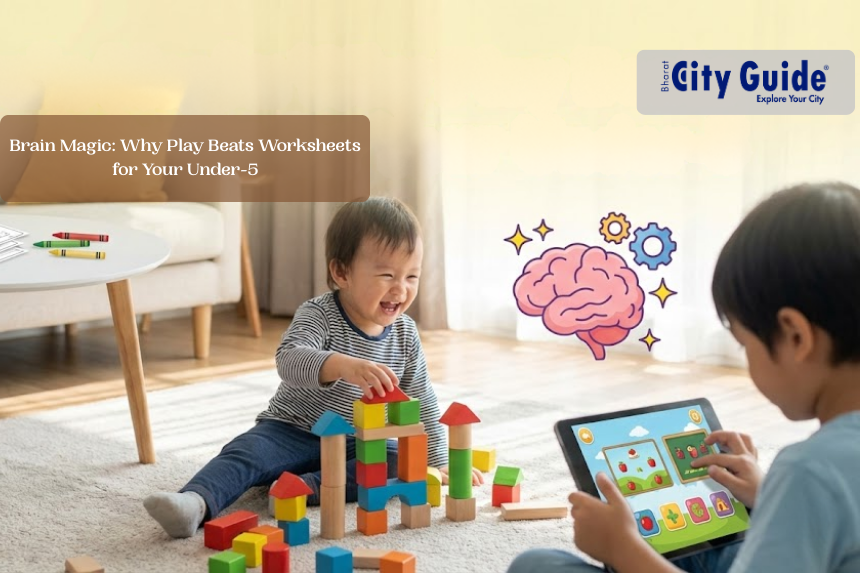
In a Delhi playschool classroom, little Aarav sits quietly in the corner, stacking wooden blocks again and again. The colorful ABC chart on the wall goes unnoticed. While other children repeat letters, Aarav experiments—balancing, toppling, rebuilding.
- He’s Ignoring the ABC Chart—And That’s a Good Thing
- The First Five Years: A Once-in-a-Lifetime Brain Window
- Why Worksheets Feel Productive (But Aren’t)
- The Science of Play: How Learning Really Happens
- Why This Matters Especially for Indian Parents
- Play Builds the Brain for the Future, Not Just Exams
- Practical, Brain-Boosting Play Tips You Can Start Today
- Common Pitfalls That Limit Brain Growth
- But What About School Readiness?
- A Gentle Reframe for Parents
- Try This Today
You watch and worry:
“He’s not learning anything.”
But here’s the truth that might surprise you:
In that moment, Aarav’s brain is working harder than it ever would on a worksheet.
What looks like “just play” is actually serious brain construction underway.
The First Five Years: A Once-in-a-Lifetime Brain Window
From birth to age five, a child’s brain develops at a speed never repeated again.
By age 5:
- Nearly 90% of brain wiring is complete
- Millions of neural connections form every second
- The foundation for thinking, emotions, and learning is laid
And here’s the key insight:
👉 These connections grow through play, movement, touch, and exploration—not through drills or memorization.
Why Worksheets Feel Productive (But Aren’t)
Worksheets give adults visible proof:
- Ticked boxes
- Traced letters
- Early reading milestones
They look like learning.
But for under-5 children, worksheets mainly train:
- Sitting still
- Following instructions
- Short-term memory
They do not effectively build:
- Problem-solving
- Creativity
- Emotional regulation
- Flexible thinking
In fact, pushing academics too early can short-circuit natural curiosity.
The Science of Play: How Learning Really Happens
When children play freely, multiple brain regions activate at once.
Block play, for example, strengthens:
- Spatial awareness (math foundation)
- Cause and effect reasoning
- Hand-eye coordination
- Persistence and focus
Pretend play develops:
- Language
- Emotional intelligence
- Social understanding
Outdoor play builds:
- Motor skills
- Risk assessment
- Confidence
Play is not a break from learning.
Play is learning.
Why This Matters Especially for Indian Parents
In India, academic pressure starts early.
Many parents worry:
- “Other kids are reading already.”
- “Will my child fall behind?”
- “Should I start tuition?”
But global research—and real-world outcomes—show that early academic push does not create long-term advantage.
Countries with play-based early education consistently outperform others in:
- Innovation
- Problem-solving
- Adaptability
These are exactly the skills tomorrow’s AI-driven jobs will demand.
Play Builds the Brain for the Future, Not Just Exams
The world your child will grow into is unpredictable.
By 2040, success will depend on:
- Creativity
- Emotional intelligence
- Collaboration
- Adaptability
These skills cannot be drilled on worksheets.
They are wired through play.
Practical, Brain-Boosting Play Tips You Can Start Today
You don’t need fancy toys or expensive classes.
1. 30 Minutes of Unstructured Play Daily
Unstructured means:
- No instructions
- No learning outcome
- No interference
Ideas:
- Blocks
- Mud and water
- Empty boxes
- Kitchen utensils
Why it works:
- Encourages independent thinking
- Builds attention span naturally
- Strengthens executive function
2. Narrate, Don’t Direct
Instead of teaching, observe and describe.
Say:
“Wow, that tower is tall—almost like the Qutub Minar!”
This:
- Expands vocabulary
- Connects learning to real-world concepts
- Keeps the child in control
3. Say No to Screens Before Age 2
Real brains grow through real experiences.
Touching, climbing, stacking, and exploring activate senses screens cannot.
Excessive screen use in early years is linked to:
- Reduced attention span
- Delayed language development
- Weaker emotional regulation
Choose connection over convenience whenever possible.
Common Pitfalls That Limit Brain Growth
❌ Swapping Play for Tuition
Early tuition may impress relatives, but it often:
- Reduces curiosity
- Increases performance anxiety
- Kills creativity
Learning becomes a task, not a joy.
❌ Over-Structured Schedules
Children need boredom.
Boredom sparks imagination.
When every minute is planned, the brain loses space to wander—and wandering is where innovation begins.
But What About School Readiness?
Here’s the counterintuitive truth:
Children who play more in early years often:
- Learn to read faster later
- Show stronger math reasoning
- Adjust better to school routines
Why?
Because their brains are flexible, confident, and curious.
A Gentle Reframe for Parents
If your child prefers blocks over books right now, it doesn’t mean he’s behind.
It means:
His brain is building the foundation that books will stand on later.
Play is not wasted time.
Play is brain magic.
Try This Today
Sit with your child during play.
Don’t teach.
Don’t correct.
Just watch.
You’ll witness learning unfold naturally.
Reflection Question
What’s your child’s go-to play today—and how can you protect time for it?